Melody and arrangement
Plaid: Make Two Melodies Talk, Not Fight
Two good melodies can sound poor together because both want the listener at the same moment. Before you reach for EQ or a side chain, decide who speaks when.
Below is an invented two-part, two-bar exercise in A minor with exact notes. Play a crowded version, then an interacting one, then change only the articulation. It is our exercise, inspired by the melodic interplay people associate with Plaid, not an account of how the duo write.
Two hooks, one bar
You write a lead you like. You write a second line you also like. Together, each has lost something, and the reflex is to call it a mix problem: duck one, carve the other, make the second patch darker. Those moves are fine, but they come after the musical decision and can't tell you which line the listener should follow. If both lines attack together, turn at the same moment and sit in the same register, nobody has decided. EQ on top of that is a tidy way of keeping the indecision.
What Plaid said, and what they didn't
Plaid's melodies are a reason to think about this, not a manual for it. Asked in a 2019 Inverted Audio interview (external site, opens in a new tab) how their melodies and ideas arise, Andy Turner said they were more like "explorers", waiting to "identify a new riff or melody". That is about finding material, not about how two lines share a bar, even though the question mentioned melodic and rhythmic interplay. In Headphone Commute, September 2019 (external site, opens in a new tab), the duo said the music "almost always comes first", though a patch can "take a composition in a new direction", and that of one track, "Los", a few rhythms running together can each be emphasised by pushing one line or another. That is a remark about one track, and about level. In Attack Magazine, August 2015 (external site, opens in a new tab), Turner said melody is "still very important" to them and that they hope their tracks don't "rely completely on the timbre of the instruments".[1][2][3]
None of that describes how they arrange two lines, and we don't claim to know. What we take from it is a priority: notes before sound, and sound as a way of clarifying them. The exercise below is our own, built on that order of work.
Two lines, written down
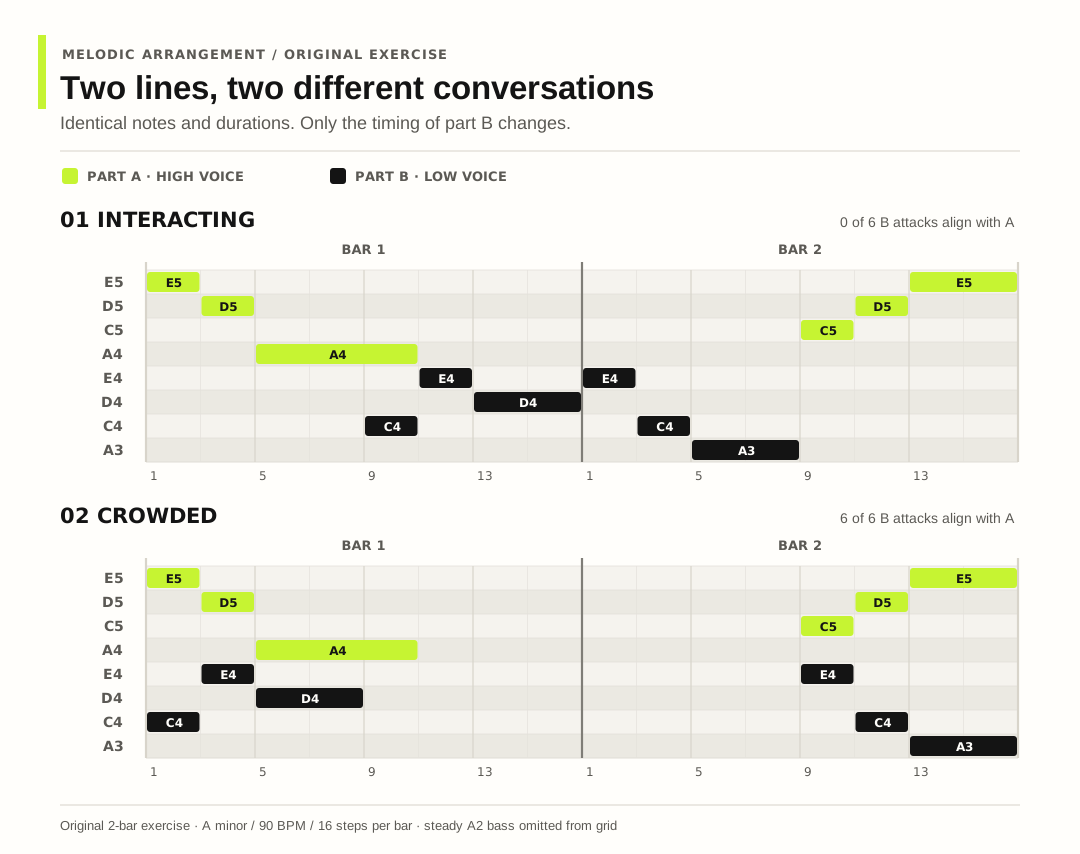
This is invented for this article and isn't taken from any recording. Set 90 bpm in 4/4 and a sixteenth-note grid, so each step lasts 0.17 seconds and the two bars take 5.3 seconds. Hold A2, about 110 Hz, on a plain sine across both bars. Give the two parts any two stock synth patches, with Part A above Part B. The only pitch classes are A, C, D and E, all in both A natural minor and A minor pentatonic. Steps run 1 to 16 in each bar, and lengths are counted in steps.
Part A, the upper line:
- Bar 1, step 1: E5, length 2.
- Bar 1, step 3: D5, length 2.
- Bar 1, step 5: A4, length 6, so it runs on to step 10.
- Bar 2, step 9: C5, length 2.
- Bar 2, step 11: D5, length 2.
- Bar 2, step 13: E5, length 4.
Part B, the lower line, in the interacting version:
- Bar 1, step 9: C4, length 2.
- Bar 1, step 11: E4, length 2.
- Bar 1, step 13: D4, length 4.
- Bar 2, step 1: E4, length 2.
- Bar 2, step 3: C4, length 2.
- Bar 2, step 5: A3, length 4.
A takes the first half of bar 1, falling, then waits and returns in the second half of bar 2, rising. B fills the gap with a different shape (up a major third, down a tone, up a tone, down a major third, down a minor third) in a register that stays below A's lowest note: A3 to E4 against A4 to E5. There is one overlap. A's last note in bar 1 is held for two steps under B's entry on step 9, and there it sounds against C4 as a major sixth, 9 semitones, with a frequency ratio of about 1.68.
Why a held note isn't a rival
That held A4 is two octaves above the bass A: 440 Hz against 110 Hz, a ratio of 4 to 1. It repeats a pitch the ear already has from the bass, so it adds sustain to the harmony rather than a new event to follow. A note that stays put under a reply can read as part of the frame, a bit like a pedal, while the other voice moves. That is our reading of the arrangement, and nobody has auditioned it here.
Now crowd it
The control keeps the same pitches, lengths, patches and levels. Move B's bar 1 notes eight steps earlier, so they start on steps 1, 3 and 5, and its bar 2 notes eight steps later, so they start on steps 9, 11 and 13. Now each of B's six attacks lands on an attack from A. The gaps between them are 16, 10, 7, 8, 14 and 19 semitones, and some of those combinations may add tension depending on your patches. The test here is what happens when every entry coincides. The only thing that changed is the arrangement.
Whether it sounds crowded is for you to judge, and your judgement is the result. We haven't rendered or auditioned either version, so treat "crowded" as the hypothesis you are testing. Ask each version one question: where does your attention go on step 5 of bar 1?
Tell them apart without touching the notes
Go back to the interacting version and change only articulation, keeping every note, velocity and level fixed. Try giving A a fast attack, a brighter filter and a decay of around 200 ms, which gives each note a shorter, pluckier body. A two-step note lasts 0.33 seconds; if you want it to clear before the next attack, lower the sustain or shorten the release too. Give B a slower attack of 20 to 30 ms, a darker filter and a longer release. These are starting values to try, not settings anyone used.
Notice what that does and doesn't do. It labels the lines, so the ear can tell whose note it just heard. It doesn't repair a clash between them. If the crowded version annoys you, a different envelope on B won't make it less crowded.
Arrangement fix or mixing fix
A quick test: mute one part and check the other still reads as a phrase. Then play both and say what's wrong. If notes attack together, turn together or repeat each other's shape, that is an arrangement problem, and the fixes are musical: move an entry, shorten a note, change the contour, delete a note. If the notes are well placed and one line is still hard to follow because it is quiet or sits in the same frequencies as something else, that is a mixing problem, and level or EQ is the right tool. Where two lines have to overlap in range, putting them in different octaves is a compositional choice too. EQ can make room for a line you have already decided matters. It can't decide that for you.
You don't need to buy anything for this. Two stock patches, a sine bass and ten minutes will do. Programme the notes, swap the half-bars, then change the attack and decay. If you prefer the crowded version, keep it, and write down why. The aim is to know who is speaking in each bar.